
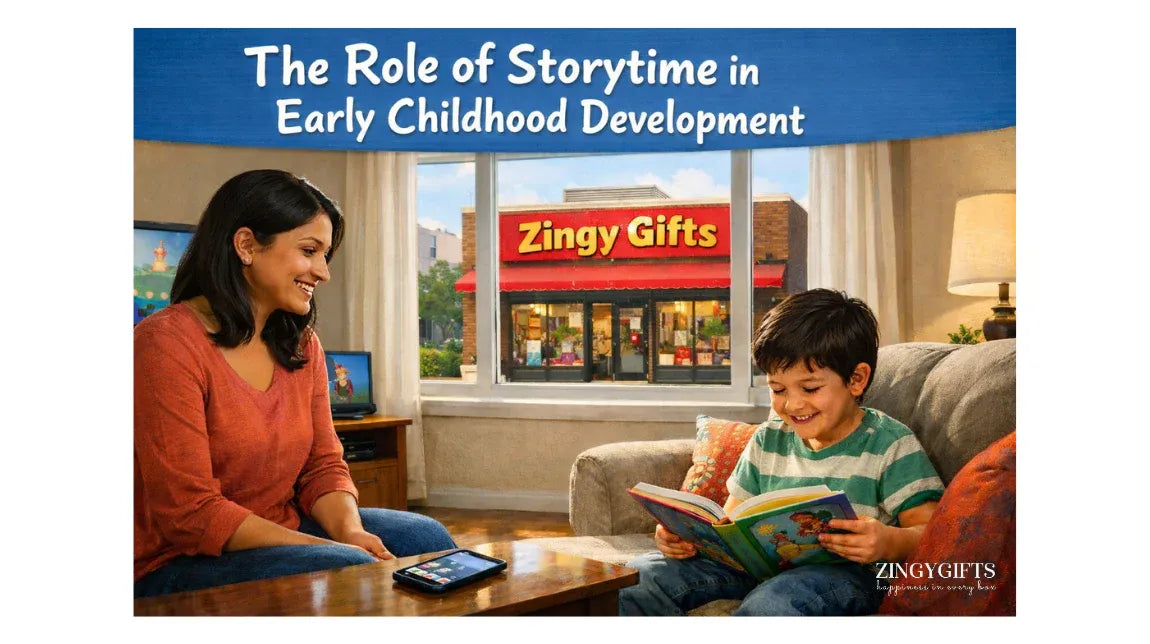
The Role of Storytime in Early Childhood Development
(By Vikram Pratap, Founder – Zingy Gifts)
Let me start with a simple memory.
Most of us didn’t grow up with fancy learning apps or screens in every room. We grew up with someone—usually a parent or grandparent—sitting beside us, telling a story. Sometimes from a book. Sometimes from memory. Sometimes made up on the spot.
And yet, those stories stayed.
Today, as a parent and as someone who has spent years creating gifts for families, I’ve seen one thing very clearly: storytime is not just a routine—it’s a foundation.
Especially in early childhood.
How Daily Storytelling Shapes a Child’s Brain (Ages 2–6)
Between the ages of 2 and 6, a child’s brain develops faster than at almost any other stage of life. This is when neural connections related to language, imagination, emotional understanding, and attention are forming.
Daily storytelling plays a quiet but powerful role here.
When you read aloud to a child:
- Their brain learns how language flows
- New words attach to emotions and images
- Listening skills improve naturally
- Focus and patience develop without force
This isn’t about teaching alphabets aggressively. It’s about exposure.
A child who hears stories daily begins to predict what comes next, recognize patterns, and connect meaning to words. Over time, this builds stronger comprehension skills than rote learning ever could.
What’s interesting is that children don’t need complex stories. They need familiar voices, repetition, and connection.
That’s why parents often notice children asking for the same story again and again. Repetition strengthens neural pathways. The brain loves familiarity.
From Vocabulary to Empathy: Why Storybooks Matter in Early Childhood
Storytime doesn’t just build language. It builds emotional intelligence.
When a child hears about characters feeling scared, excited, sad, or brave, they begin to understand emotions—first in stories, then in real life.
This is how empathy starts.
A simple story where a character helps a friend or solves a problem teaches:
- Perspective-taking
- Cause and effect
- Kindness without lectures
And when the story features the child themselves—as the hero—this impact becomes even deeper.
That’s one reason parents today are increasingly choosing personalized story books. When children see their name and photo inside a story, they don’t just listen—they participate.
At Zingy Gifts, our collections of
👉 Personalized Books for Kids
and
👉 Custom Books for Kids with Names
are designed with this exact developmental stage in mind. These books aren’t about novelty; they’re about identity and confidence.
When Storytime Becomes a Bonding Ritual
One thing I’ve observed across hundreds of parent conversations is this:
storytime often becomes the calmest moment of the day.
No instructions.
No corrections.
No pressure.
Just presence.
In those 10–15 minutes, children feel heard and safe. Parents slow down. And that emotional safety plays a huge role in early development.
Children who associate learning with warmth and connection tend to:
- Ask more questions
- Express themselves freely
- Feel confident exploring new ideas
This is why storytime is recommended not just by educators, but also by child psychologists.
Choosing the Right Stories Matters
Not all books engage children in the same way.
In early childhood, stories work best when they:
- Are age-appropriate
- Use simple, rhythmic language
- Have relatable characters
- Encourage imagination, not instruction
That’s why story themes matter.
For example, many parents love adventure-based stories because they naturally combine curiosity with learning. Some of our most loved titles include:
- Personalized Story Books for Kids (1–8 Years)
- Harry Potter Theme Custom Story Book
- Space Adventure Custom Storybook
These stories invite children to imagine, explore, and think—without turning reading into a task.
Storytime vs. Screens (A Quiet Comparison)
I won’t say screens are evil. They’re part of modern life.
But screens are passive. Stories—especially read aloud—are interactive.
When parents read:
- Children ask questions
- Pause to comment
- React emotionally
This back-and-forth is critical for brain development, especially in the early years.
Many parents tell me they notice better sleep, calmer evenings, and stronger attention spans when storytime replaces screen time before bed.
Storybooks as Return Gifts: A Growing Indian Trend
One interesting shift I’ve seen in India is how parents are rethinking return gifts for birthdays and school events.
Instead of plastic toys that break in two days, parents are choosing:
- Mini personalized story books
- Custom name-based books
- Age-appropriate reading gifts
Why? Because they serve a purpose after the party ends.
A storybook becomes:
- A bedtime read
- A learning tool
- A memory of the celebration
And most importantly, it’s something parents actually appreciate receiving.
Final Thoughts from Me
Storytime doesn’t require perfection.
It doesn’t require expertise.
It just requires consistency.
A few minutes a day can shape how a child thinks, feels, and learns.
As a founder, I work with products.
As a parent and observer, I work with moments.
And storytime, without doubt, is one of the most powerful moments you can give your child.
FAQs (Indian Parent Search Intent)
1. At what age should parents start reading to kids?
Parents can start as early as infancy. Even babies benefit from hearing familiar voices and rhythmic language.
2. How long should storytime be for toddlers?
10–15 minutes daily is enough. Consistency matters more than duration.
3. Are personalized story books good for early learning?
Yes. Children engage more when they see their name and photo, which improves attention and confidence.
4. Can storybooks be used as birthday return gifts?
Absolutely. Personalized or age-appropriate storybooks are becoming popular return gifts in India.
5. Are storybooks better than toys for development?
Both have a role, but storybooks support language, empathy, focus, and parent-child bonding more consistently.